- Silage Additives
Silage Quality: Key Points to Monitor on the Farm
Silage quality can have a direct impact on feed intake, milk production and animal health. But how can forage quality be easily assessed on the farm? What warning signs should farmers look out for?
Amélie Cornillet, Product Manager and Ruminant Veterinarian at VITALAC, shares the key points to monitor, both at the silage clamp and within the herd.

How Can Silage Quality Be Quickly Assessed on the Farm?
Several simple criteria can be used to quickly assess silage quality. The first step is visual inspection.
Upon reaching the silage clamp, check its uniformity, the condition of the silage face, and look for any areas of different colours or signs of mould.
A closer inspection also allows you to assess fibre length. In maize silage, for example, kernel processing is an important factor to examine.
What Checks Can Be Carried Out Directly at the Silage Face?
Visual inspection can be supplemented by a few simple checks.
Silage compaction can be assessed by trying to push a finger into the silage face: it should not be possible to push it in beyond the first finger joint.
Dry matter content can also be initially estimated by squeezing a handful of silage. However, this assessment remains very approximate. It can then be supplemented by a measurement using equipment such as an air fryer, which can provide a measurement of the forage dry matter content in approximately 30 minutes.
Why Is It Also Important to Monitor Silage Temperature?
Temperature is another important factor to monitor. It can be assessed by touch or measured using a food thermometer. Longer temperature probes can also be used to measure the temperature inside the silage face, at a depth of approximately one metre.
Can Smell Provide an Indication of Silage Quality?
Yes. Smell can also provide valuable information. Good-quality, well-preserved silage has a characteristic lactic acid smell. Conversely, well-preserved silage should not have rancid (butyric acid), alcoholic or mouldy odours.
What Are the First Signs of Poor-Quality Silage in the Herd?
The first sign is generally a reduction in feed intake: cows eat less or may refuse certain forages. These changes in feed intake can affect milk production and, when significant, animal health.
What Are the Potential Health Consequences of Poor-Quality Silage?
The health consequences can vary. In the presence of moulds or the mycotoxins they produce, digestive disorders may occur, potentially including diarrhoea or even haemorrhagic jejunal syndrome associated with certain mycotoxins.
Other effects are also possible, including an increase in mastitis and infectious diseases. Abortions or, more rarely, neurological disorders may also be observed.
Key Takeaways
Silage assessment starts directly at the silage clamp. Visual appearance, uniformity, silage face stability and compaction, fibre length, kernel processing, dry matter content, temperature and smell are all simple criteria to monitor.
Within the herd, reduced feed intake or feed refusal should also be considered a warning sign, as poor silage quality can affect milk production and animal health.
Take Action from Ensiling to Preserve Forage Quality
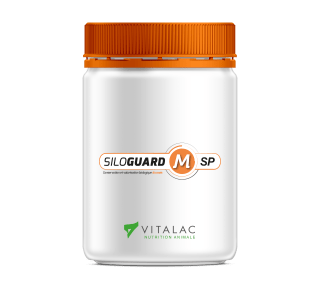
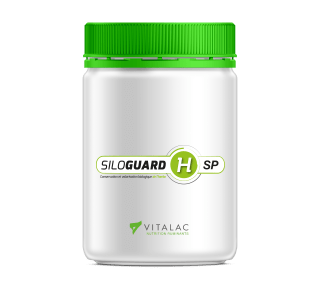
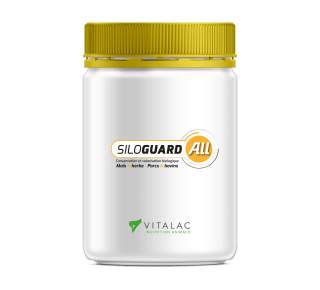
Good silage quality also depends on effective preservation from the moment of ensiling. To support farmers at this stage, VITALAC offers the SILOGUARD range of silage additives, suited to different types of forage: SILOGUARD MAÏS SPEED, SILOGUARD HERBE and SILOGUARD ALL. These solutions are part of an approach designed to promote effective forage preservation and maintain its quality until it is fed to the animals.
Discover the SILOGUARD range and find the right solution for your silage.