- Dairy and beef cattle
- Dairy cows
- Reproduction
- Ruminants
How the 100 days around calving shape the productive life of dairy cows
Around calving, the first days of lactation bring together major technical challenges. Metabolic health, feed intake, rumen balance and reproduction: managing this period effectively is key to the performance, longevity and sustainability of dairy herds.
 With expert advice from Dr Emilie Knapp, a Rum’Experts veterinarian based in Belgium, who spoke at our technical days.

Dairy cow longevity is now a central concern in herd management. It addresses economic, environmental and social challenges, and can no longer be considered solely in terms of the number of lactations. One indicator is now widely recognised: the quantity of milk produced per day of life, reflecting performance, robustness and the consistency of herd management practices.
The work presented by Émilie Knapp, a veterinarian specialised in nutrition and transition management, shows that the 60 to 100 days around calving represent a key period. It is during this window that most metabolic, health and reproductive imbalances develop, influencing the cow’s entire productive life.
The 100 days: a high-stakes period
Field data and available references show a gradual improvement in longevity on dairy farms, with an increase in average lifespan and in milk produced per day of life. However, this progress remains fragile and highly dependent on early-lactation management.
The studies presented highlight that:
- The risk of culling doubles during the first 60 days of lactation.
- A significant proportion of early culling concerns cows that were unable to express their full potential.
- The first 30 days after calving are particularly sensitive, both in terms of health and metabolism.
The main causes of culling — reproductive disorders, mastitis, lameness or reduced production — very often originate during this period. A poorly prepared transition weakens the cow from the very start of lactation and, as a direct consequence, shortens her productive life.


The first 30 days are decisive, but it all starts before calving.
Metabolic imbalances:
the tipping point
Around calving, dairy cows undergo normal physiological adaptations. Problems arise when the intensity or duration of these imbalances exceeds the cow’s ability to adapt.
Hypocalcaemia: an underestimated imbalance
Calcium mobilisation begins immediately and naturally at the start of lactation to meet the demands of colostrum and then milk production. Hypocalcaemia occurs when this mobilisation becomes insufficient. While clinical forms are easy to identify, subclinical forms are by far the most common, particularly in multiparous cows.
Even when moderate, hypocalcaemia affects:
- Feed intake and rumen motility
- Muscle contraction, including calving, placental expulsion and rumen function
- Immunity and resistance to infection
- The risk of secondary disorders, including mastitis, metritis and lameness
The higher the number of lactations, the lower the cow’s ability to regulate calcium balance. This explains the increased health and culling risk observed in older cows.
Negative energy balance: a matter of threshold
Although inevitable in early lactation, negative energy balance becomes problematic when it is too severe or prolonged. It leads to excessive mobilisation of body reserves, increased pressure on the liver, and impaired reproductive and immune function.
As Émilie Knapp points out, the analysis cannot be limited to a single indicator, such as BHB, NEFA or body condition score. It is the combined and dynamic interpretation of metabolic parameters that makes it possible to identify the real at-risk situations.
Transition: preparing before calving to succeed afterwards
A successful start to lactation is prepared before calving.
The dry period is a strategic phase that influences feed intake, rumen adaptation and the cow’s ability to cope with the demands of early lactation.
The key technical levers are now well identified:
- Maximise actual feed intake, without excess energy
- Limit sudden changes in ration and group management
- Preserve rumen and hindgut stability
- Precisely adjust energy, protein, mineral and trace element supply
- Ensure permanent access to water, feed and comfortable lying areas
- Implement targeted metabolic monitoring to objectively assess balance
A well-managed transition significantly reduces the incidence of early-lactation disorders, improves fertility and secures production throughout the cow’s productive life.
Discover our full range of services and support solutions, designed to help you manage the key levers of transition and secure the start of lactation, by clicking on our brochure below:
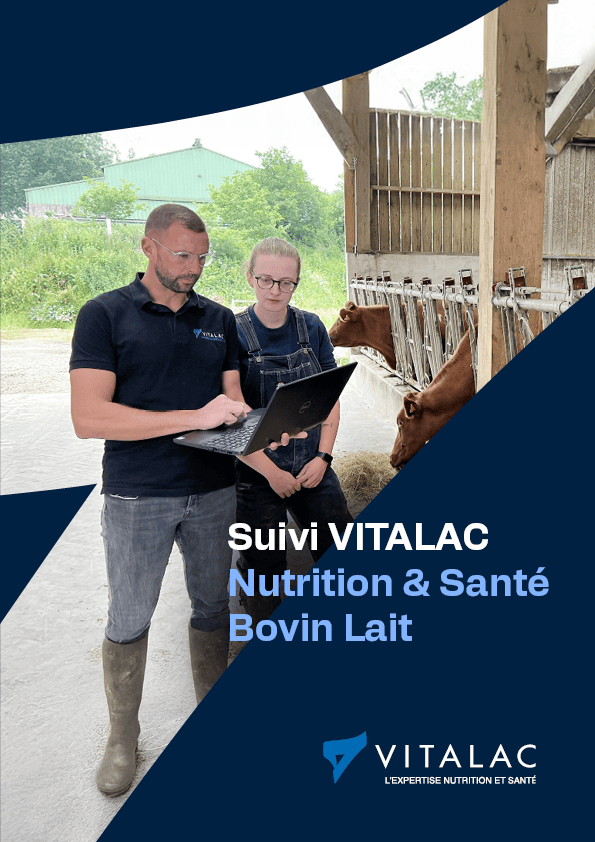

VITALAC solutions to secure the 100 days around calving
To support this key period, several VITALAC solutions can be integrated into a comprehensive prevention and monitoring approach:
- The VITACARTE range and RUMENSTIMUL to help stabilise rumen pH and support feed intake.
- XL GRAIN and RUMIX³, to limit the acidogenic potential of rations and secure the feed transition.
- MELYCHOL, to support liver and energy metabolism around calving.
- Dry cow feeding programmes and VELBOOSTER, designed to structure the transition period and limit nutritional disruptions.
- CALCIBOL, for targeted prevention of hypocalcaemia in at-risk cows.
These solutions are part of a coherent approach that can be adapted to each farming system, with one shared objective: to secure the 100 days around calving in order to sustainably improve herd longevity and performance.

Longevity is not built by chance.
The 100 days around calving bring together the most decisive technical decisions for the productive life of dairy cows.
A comprehensive approach, combining nutrition, metabolism, rumen function, comfort and monitoring, helps anticipate imbalances and sustainably strengthen animal resilience.
The aim is not to look for a miracle solution, but to implement a coherent, monitored strategy adapted to each farm, supporting both performance and sustainability.
Focus produits
Découvrez nos produits